
What Is Employee Experience? 6 Ways to Measure Employee Engagement
Employee experience (EX) is the sum of every interaction a person has with your organisation. It shapes engagement, satisfaction and performance — and you can only improve what you measure. Here is what EX means, why it matters now and the six tools modern HR teams use to track it.
The HR agenda has changed fundamentally in the last few years. Post-pandemic hybrid work, quiet quitting, the rise of Gen Z in the workforce and the global talent war are forcing organisations to listen to their people far more carefully. The classic once-a-year engagement survey is no longer enough. Hi e-learning Employee Experience Module helps HR teams take the pulse of their organisation continuously, collect feedback systematically and turn insights into action.
What is employee experience?
Employee experience (EX) is the sum of every interaction a person has with the organisation, from the moment they apply for a job to the moment they leave. Physical workplace, digital tools, the relationship with their manager, development opportunities and the company culture all shape this experience. Put simply, EX is the cumulative grade your organisation earns from each employee’s lived reality.
Experience, engagement and satisfaction are not the same
These three terms are often used interchangeably, but they measure different things:
- Employee Experience: Holistic. The sum of every touchpoint.
- Employee Engagement: An emotional commitment, motivation and willingness to put in discretionary effort. It is an outcome of experience.
- Employee Satisfaction: How content employees feel with current conditions. A more passive metric — satisfaction does not necessarily imply engagement.
An employee can be satisfied but not engaged. To unlock engagement, you have to design the experience.
Why employee experience matters so much now
Investing in employee experience is no longer optional — it is a strategic priority that drives business results. Research consistently shows:
- Engaged employees generate roughly 23% higher profitability than average employees.
- Organisations with high experience scores see voluntary attrition drop by up to 40%.
- Customer satisfaction is directly correlated with employee engagement; one cannot sustain the other.
- The cost of attracting new talent is 6-9× the cost of retaining current employees.
6 ways to measure employee engagement
There is no single golden method to measure engagement. An effective programme combines several instruments:
- Annual engagement survey: A comprehensive 40-60 question deep dive across the organisation. Runs once a year and delivers granular analysis.
- Pulse surveys: Short 5-10 question check-ins delivered monthly or quarterly. Ideal for tracking trends and spotting change early.
- eNPS (Employee Net Promoter Score): A single question — "Would you recommend this company as a place to work?" — that yields a simple, comparable engagement metric.
- Lifecycle surveys: Event-triggered surveys at moments that matter: post-onboarding, 90-day, work anniversary, promotion, exit. They give targeted insight at specific journey stages.
- Continuous feedback channel: An always-open channel where employees can share ideas, concerns or feedback at any time. Combined with the Ethics Hotline Portal, it forms a complete feedback ecosystem.
- Stay & exit interviews: Structured conversations with current employees ("why do you stay?") and departing ones. Provide rich qualitative data that surveys cannot capture.
What to look for in a great employee experience platform
When choosing a survey tool, don’t just evaluate the form builder — evaluate the end-to-end measurement-to-action ecosystem. Critical capabilities include:
- Cycle-based measurement planning: The ability to run surveys in different cadences.
- Flexible question types: Likert scales, open-ended, scoring, ranking and more.
- Department / location / role segmentation: Slice results by organisational dimensions.
- Guaranteed anonymity: So employees can give honest feedback safely.
- Trend and benchmark reports: Quarter-on-quarter change and external sector benchmarks.
- Action plan tracking: Track the improvement actions that emerge from results in one place.
- Digital HR integration: Data flow with Performance Management, Employee Offboarding and other HR modules.
How to launch an employee experience programme
An effective programme is far more than a technical rollout. A typical roadmap covers these steps:
- Understand the current state. Review existing surveys, feedback channels and exit reasons.
- Design the measurement strategy. Which metrics will you focus on — engagement, satisfaction, eNPS, culture? At what cadence?
- Build the survey content. Keep forms aligned with your culture and tone of voice, and avoid being overly long.
- Communicate transparently with employees. Be clear about the purpose, anonymity guarantees and how results will be used.
- Analyse and share results. Send segmented results to managers, share top-level findings with the whole company.
- Convert insight into action. The most demotivating message an employee can receive is "we ran a survey, nothing changed." Identify concrete actions and share progress.
- Repeat the cycle. Use pulse surveys to track whether your actions actually moved the needle.
The Hi e-learning approach
Hi e-learning Employee Experience and Engagement Module offers cycle-based measurement, flexible question types, department and role-based analytics, powerful reporting and action plan tracking. Built to work alongside Performance Management, Employee Offboarding and the Ethics Hotline Portal inside the Digital HR ecosystem. Its multilingual interface fits international teams. Managers see their own team’s scores in real time while senior leadership gets an organisation-wide trend view.
Conclusion
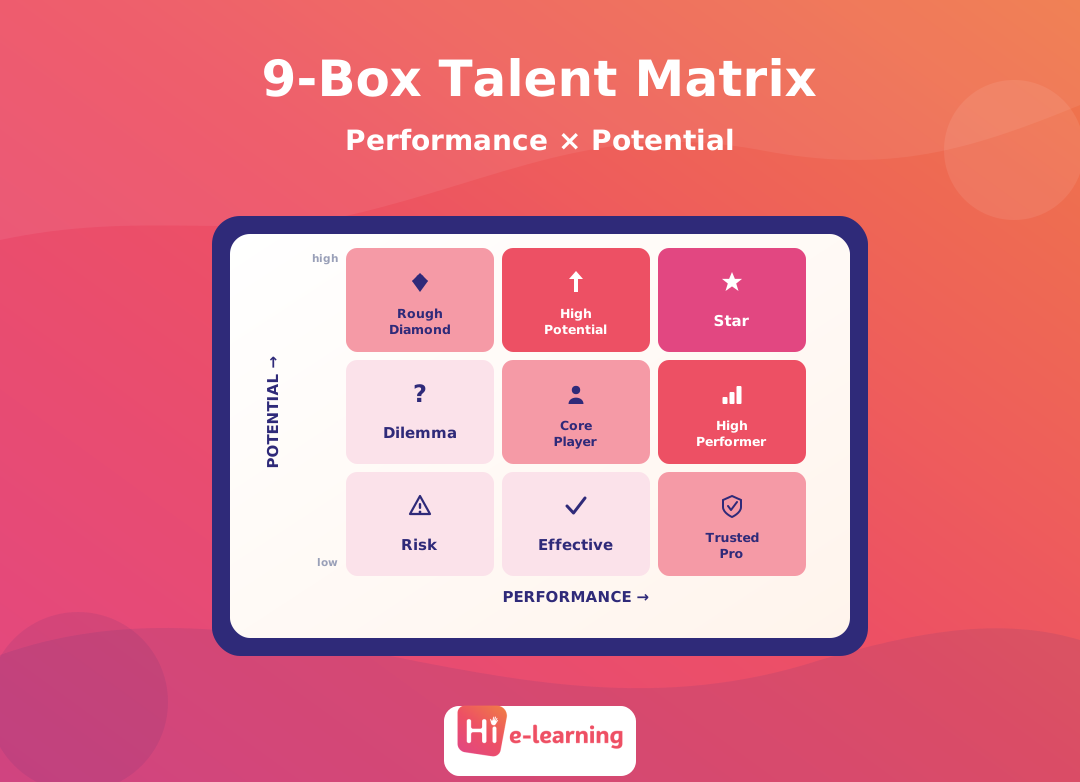
Employee experience is a strategic asset that directly affects talent attraction, retention and performance. Measuring it is not enough — you have to measure it consistently, analyse with the right segmentation and translate insight into tangible action. Combined with tools like the 9-box talent matrix and performance management system, your EX programme becomes an engine that genuinely moves business results.
Turn engagement data into action
Discover eNPS, pulse surveys, segment analytics and action plan tracking with Hi e-learning Employee Experience Module.
Discover the Employee Experience Module
SCORM-compliant LMS • Mobile-friendly learning • Multilingual content • HR integrations • Detailed reporting
Explore LMS Performance management Employee experience Employee offboarding Ethics hotline Corporate training solutions Custom e-learning content Request a Demo